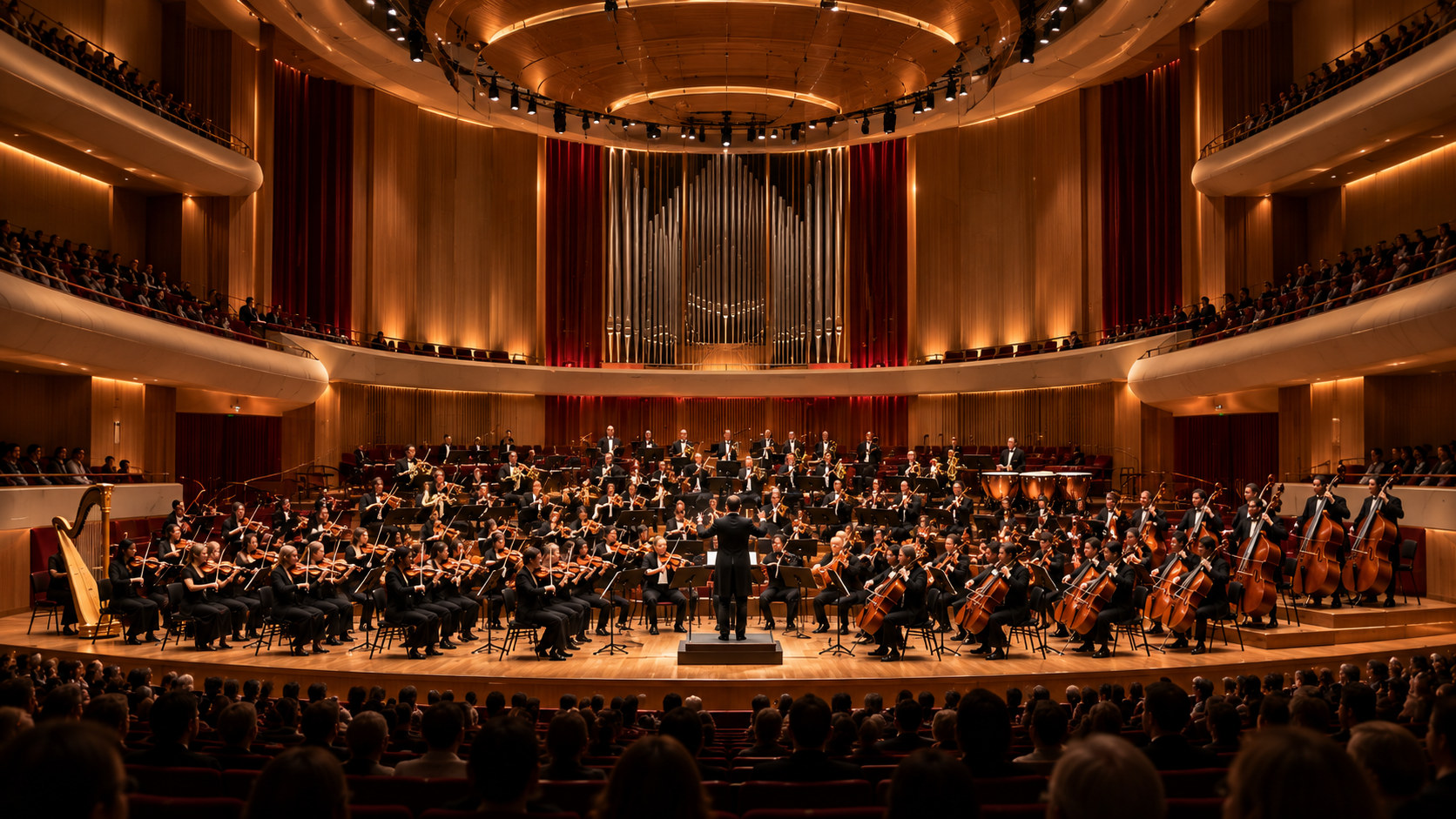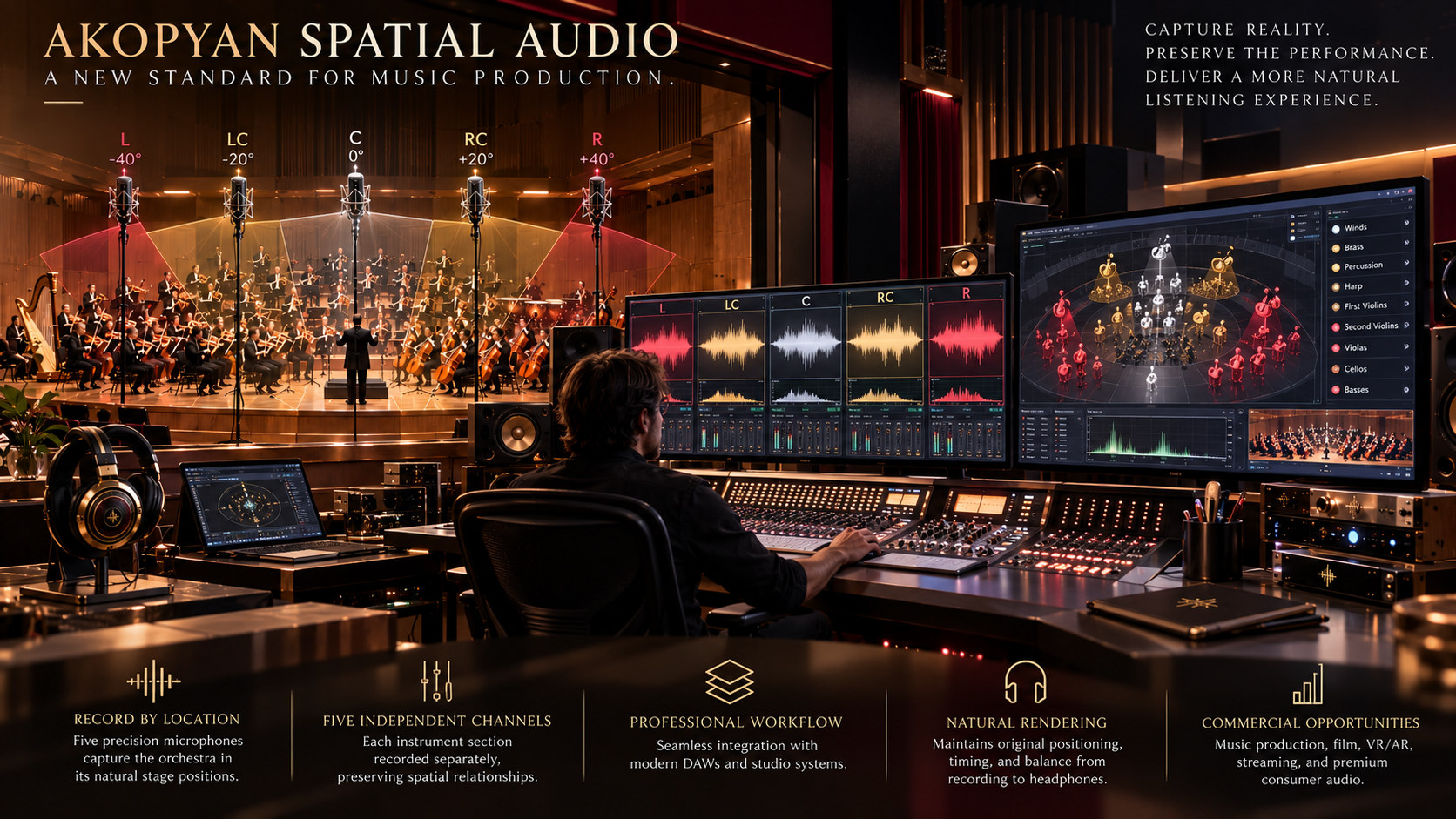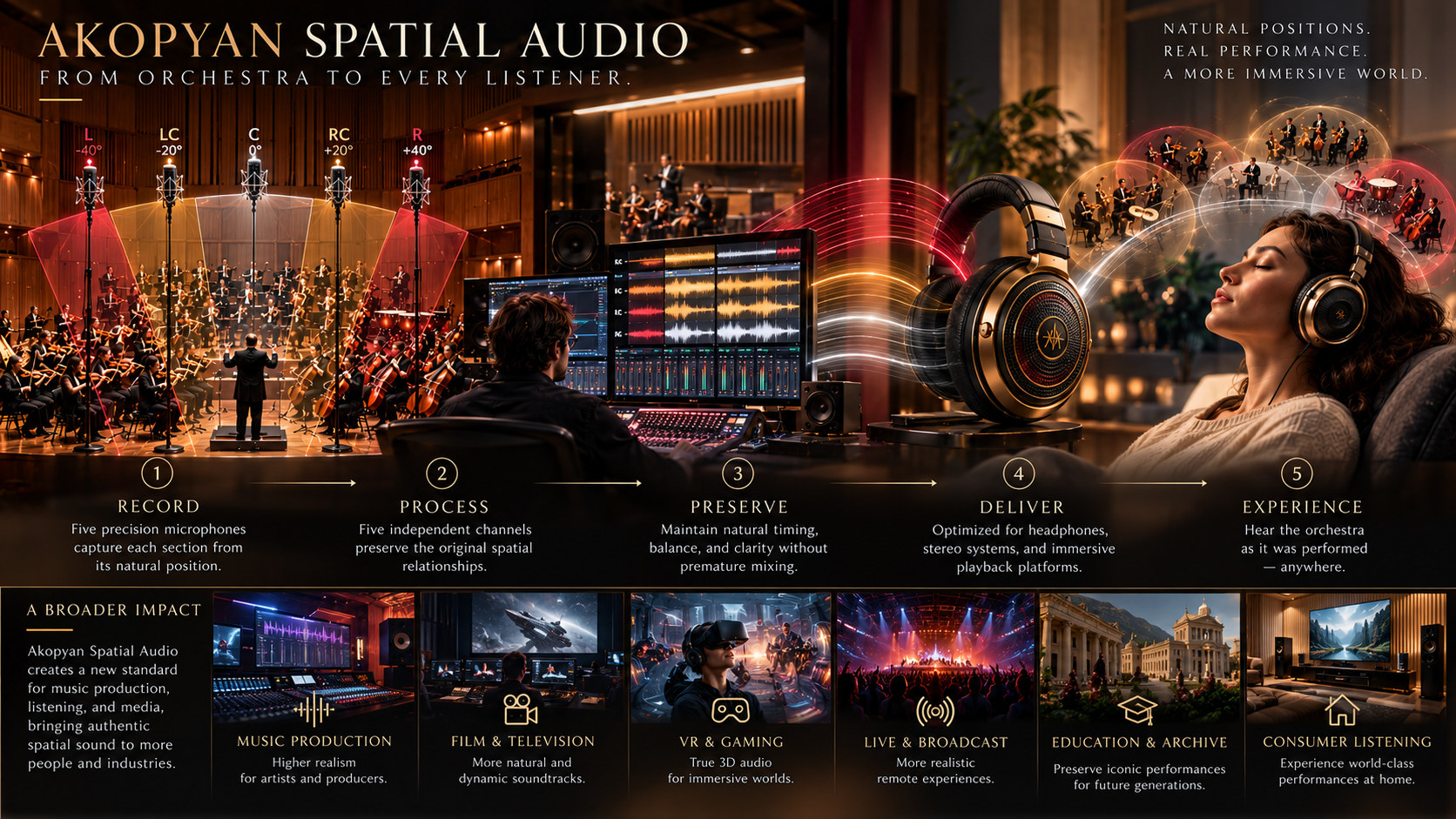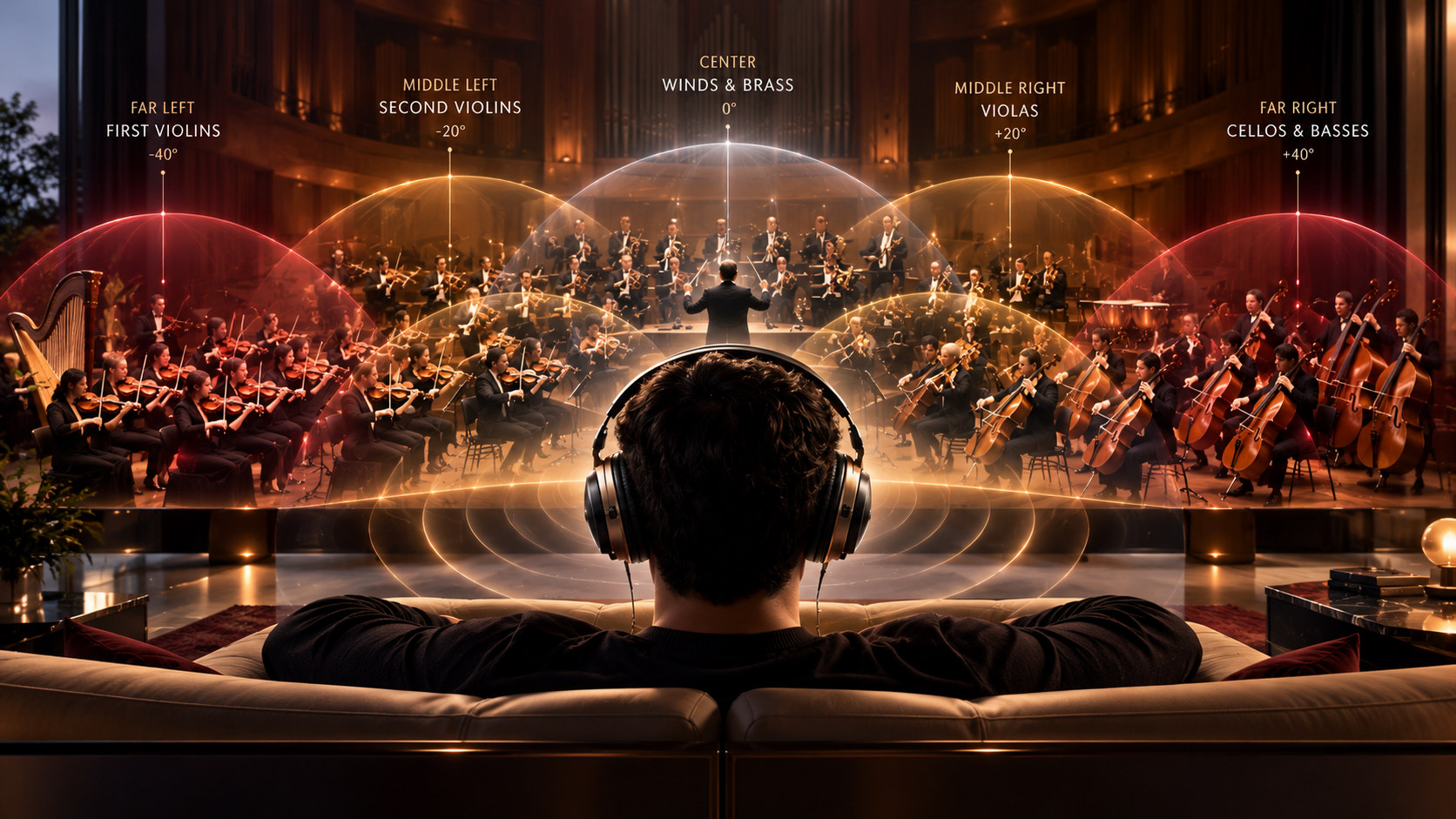
Five recording perspectives aim to preserve the orchestra’s spatial relationships—designed to bring the feeling of a live performance closer to the listener.
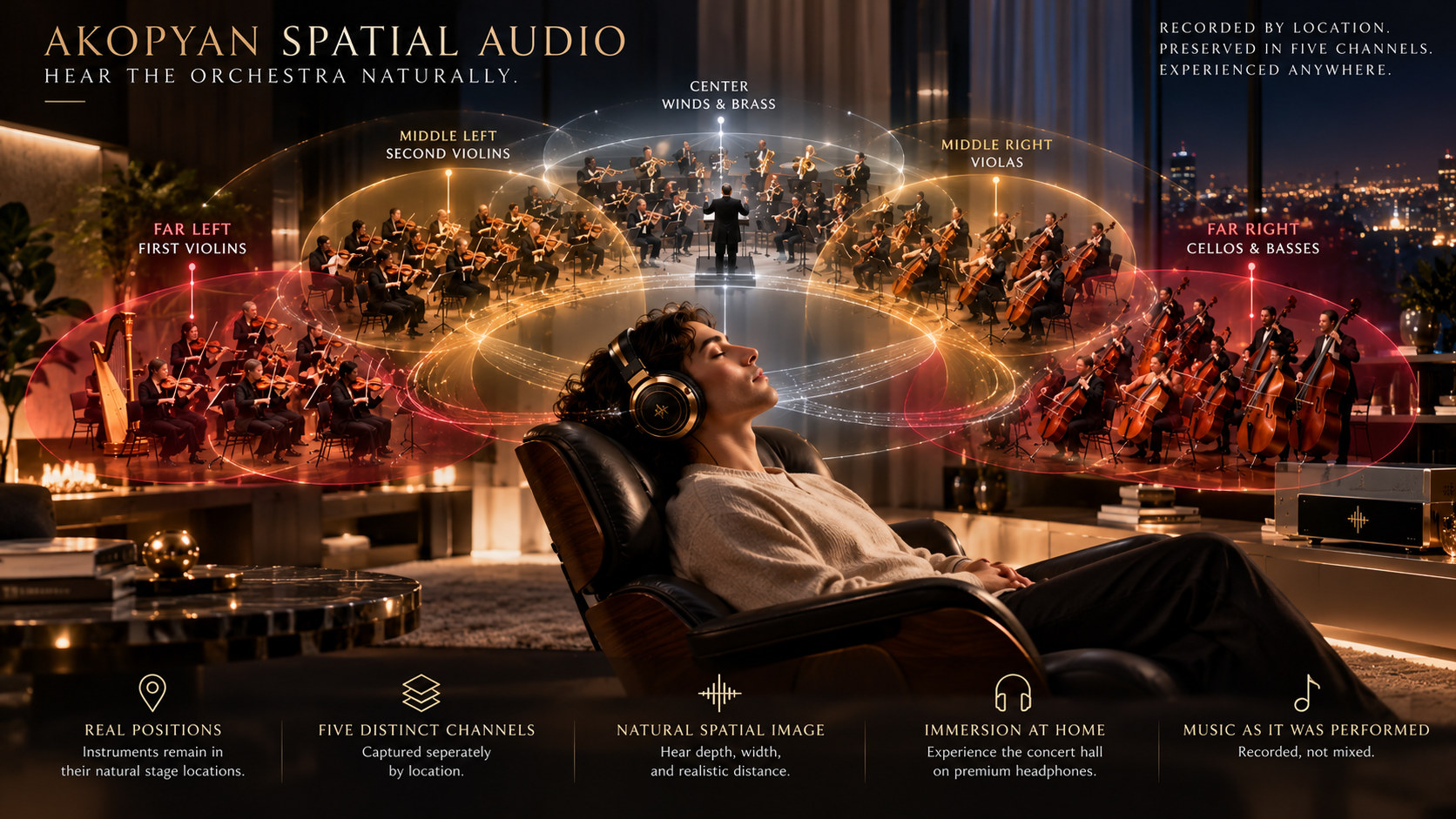
The goal is not louder music, exaggerated effects, or an artificial surround soundtrack. It is a listening experience that respects where the musicians performed.
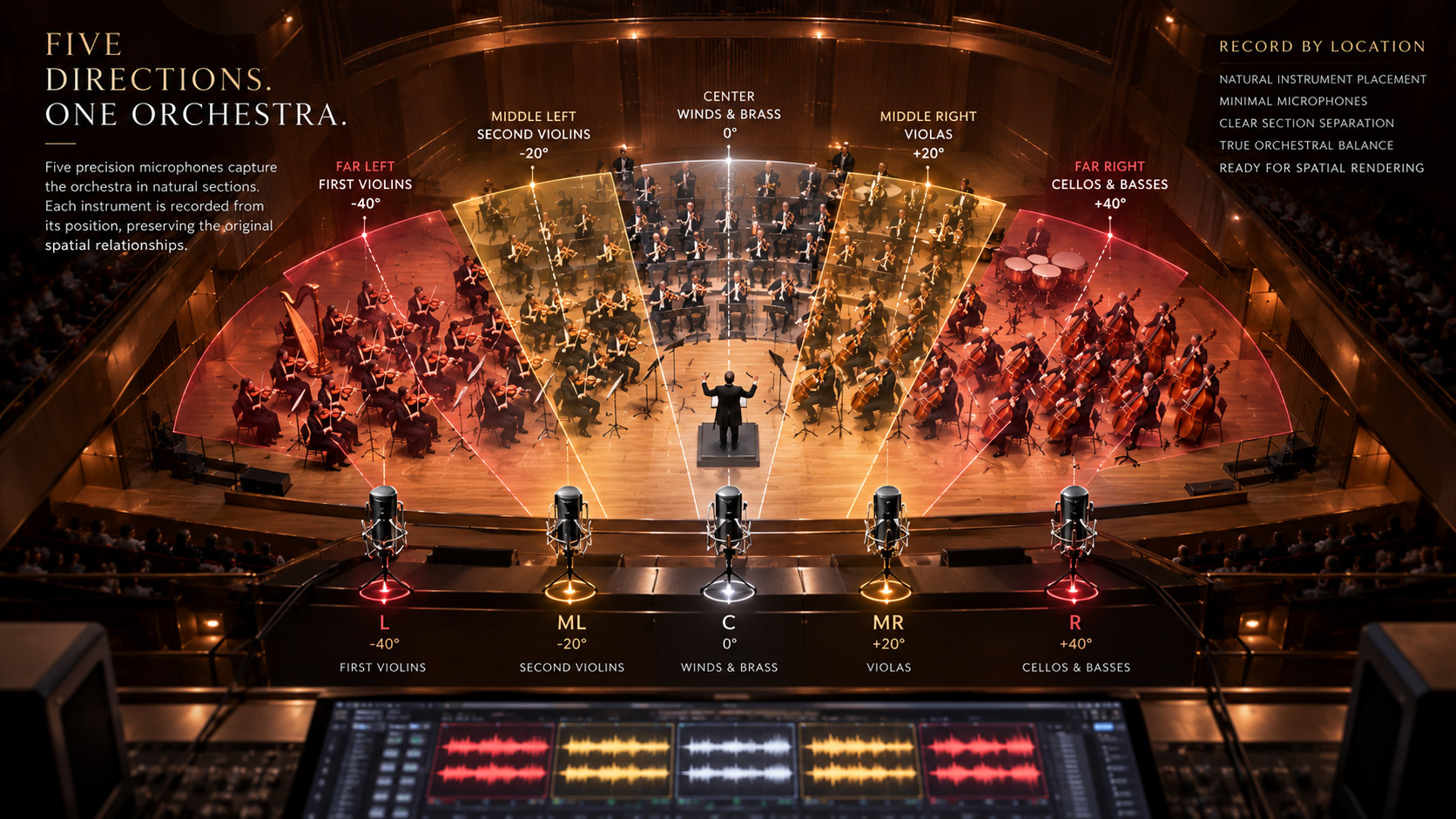
Imagine hearing the violins to your left, the central ensemble ahead, and the cellos toward your right—while the entire orchestra remains musically connected.
Record by location. Keep the five perspectives accessible. Render their relationships deliberately for each ear.

The concert hall, the conductor, and the original seating of the orchestra are the starting points—not an effect added after the music is recorded.

A proposed recording geometry with microphones aimed at −40°, −20°, 0°, +20°, and +40° relative to the orchestra’s centerline.

Far-left perspective: isolated to the left ear in the proposed enhanced-separation mode.
Model, not a listening demo. These percentages represent illustrative amplitude-mixing coefficients, not actual measured acoustic separation. Natural hearing includes cross-ear timing and frequency-dependent transfer functions.
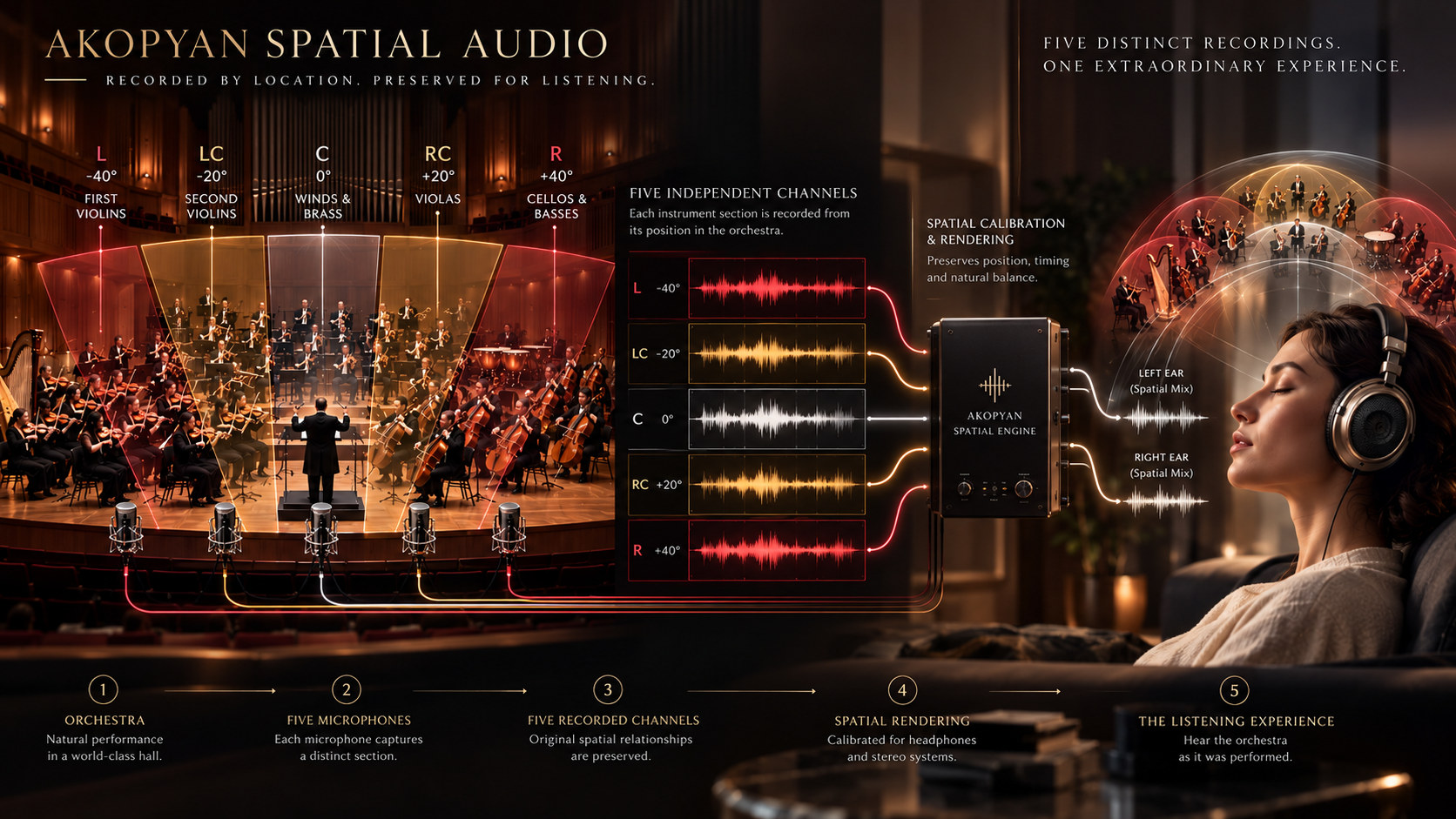
Rather than immediately reducing the recording to a fixed stereo mix, the five microphone signals remain separately accessible through the production workflow.

Five independently recorded microphone signals, each associated with a directional perspective.
Keep the signals available for editing, calibration, and spatial interpretation.
Generate two ear-specific outputs while maintaining the intended placement and musical balance.
A real instrument reaches both ears. Position is perceived through timing, level, spectral changes, and the acoustic environment.
The proposed five-channel mapping is a creative starting point. A more physically faithful renderer would use calibrated transfer functions rather than fixed percentages alone.
Imagine a violin 40° to the left. Both ears receive its sound, but not identically. The renderer's job is to preserve useful localization cues without sacrificing the music's tonal character.
A microphone pointed at one section will also capture other instruments. Directional overlap, room reflections, and comb filtering are open design challenges.
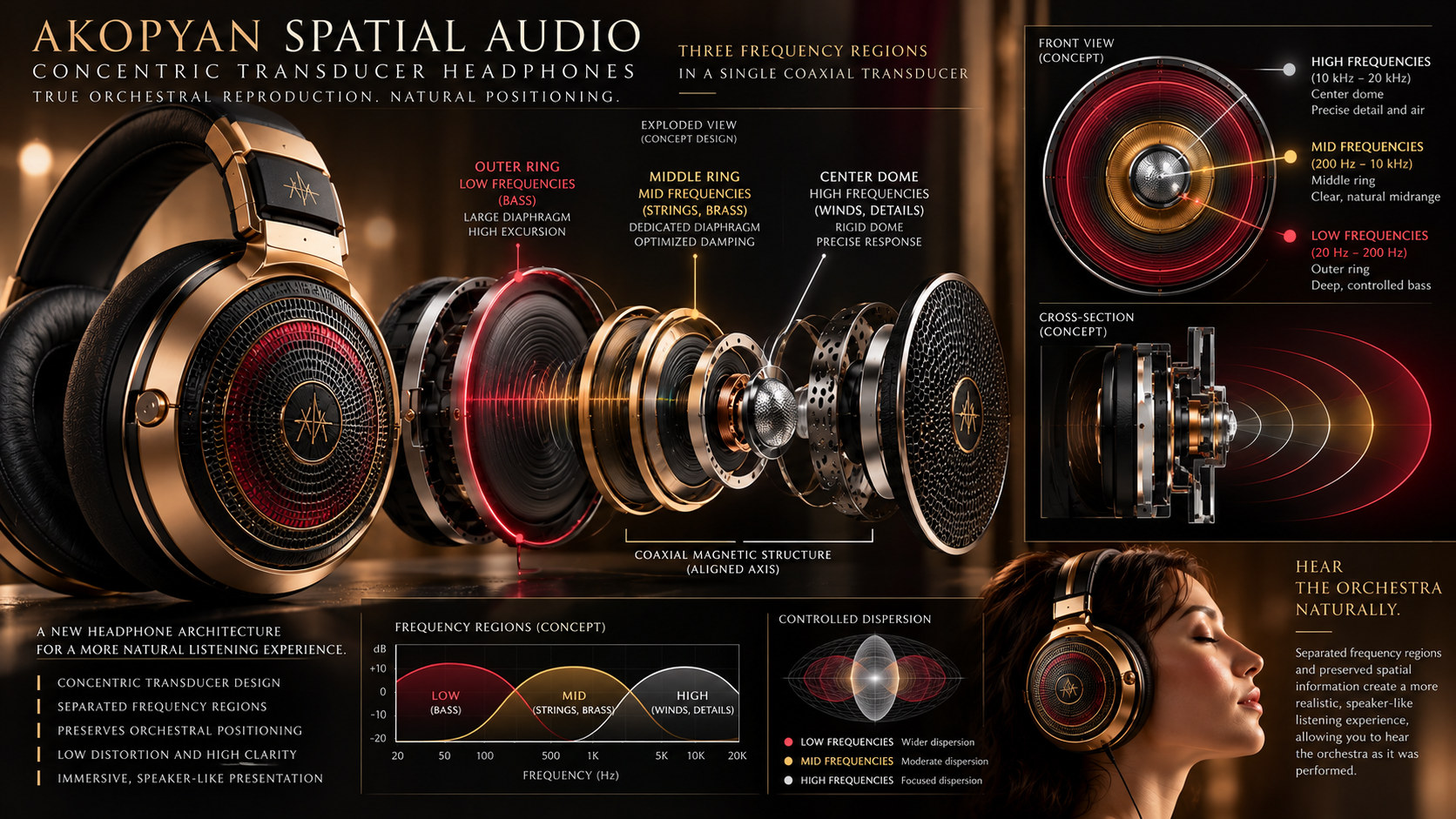
A separate theoretical hardware track explores concentric frequency-specialized radiators: an outer low-frequency annulus, a middle midrange annulus, and a central high-frequency element.

Can independently excited regions reproduce complementary frequency bands while reducing unwanted mechanical interaction?
A conventional full-range driver—or a coaxial two-way arrangement—may prove more effective. The five-channel recording concept does not depend on custom headphones.
The proposal retains five separate signals and their intended recording directions. The aim is to keep choices available during rendering instead of committing every spatial decision to a single stereo master.
No isolation is assumed. Each signal may contain several instruments and hall reflections. The theoretical model must account for overlap between channels.
They illustrate the proposed channel-to-ear amplitude mapping. They are not measured sound-pressure levels, a complete binaural model, or a listening demonstration.
The concentric transducer is a separate hardware exploration. The recording and rendering concept can be considered independently of a custom headphone design.
How should direction, timing, frequency response and shared room sound be represented together? A useful thought experiment follows one instrument through all five channels before combining them into two ear signals.
The proposed workflow connects directional capture, five-track production, spatial calibration, and headphone delivery without requiring a completely new recording studio.

Five-position capture, directional microphone research, and repeatable orchestra setup.
Track-position metadata, calibration controls, and ear-specific audio rendering.
Conventional headphone compatibility, with a longer-term premium transducer concept.
A proposed platform for spatial music production, recorded performances, educational archives, and immersive media—beginning with a focused orchestral recording problem.

Define five-channel capture and ear-rendering equations.
Investigate directional overlap, delays, and calibration requirements.
Compare the concept against conventional stereo and binaural methods.
Assess production integration, licensing, and hardware opportunities.
A research vision for recording orchestras as spatial performances—and designing a more intentional path from musician to listener.
Return to the beginning ↑