Une évolution utile
Explore motion-powered electronic indications alongside mechanical hands. The OLED is the first application of a broader research direction in energy integration, modular functions and individual expression.
MÉCANIQUE · INNOVATION · ÉLÉGANCE
A vision for the next generation of automatic mechanical watches. Montre explores how the movement, energy system, materials and personal functions can evolve together—carrying the craft of watchmaking into new possibilities.
Calibre 001 · An independent research concept for the future of automatic mechanical watchmaking
Montre proposes a platform for automatic mechanical watches with new, discreet personal functions. The ambition is to extend the possibilities of the mechanical wristwatch while preserving the craft, tactile experience and long service life that make it worth keeping.
Explore motion-powered electronic indications alongside mechanical hands. The OLED is the first application of a broader research direction in energy integration, modular functions and individual expression.
Can useful electrical energy be harvested within a wearable assembly while retaining satisfactory automatic winding, rate stability and mechanical power reserve? This is the central feasibility question.
Define a bounded feasibility study with a movement-development partner: agree the requirements, instrument a bench assembly and review measured results before committing to an integrated prototype.
Development status · Concept study. This page presents design renderings, a proposed architecture and a browser demonstration of the display experience. It does not present validated hardware or measured energy and chronometric performance. “Calibre 001” is the project designation.
An automatic watch begins with the energy of its wearer. Montre explores how that relationship could support a broader future for mechanical watchmaking. Calibre 001 investigates a mechanically coupled generator and rechargeable cell as one step toward integrated new functions. The engineering challenge is to harvest useful energy while preserving dependable mainspring winding and mechanical timekeeping.
The proposed base calibre powers the analogue hands from its mainspring; the OLED draws from a separate rechargeable cell. Both functions ultimately depend on wearer input. Generator resisting torque and its effect on mainspring winding must be measured. No external charging port is planned.
Proposed single-stator architecture and product experience; actual charging rate, operating reserve, rotor coupling and final water-resistance performance require development.
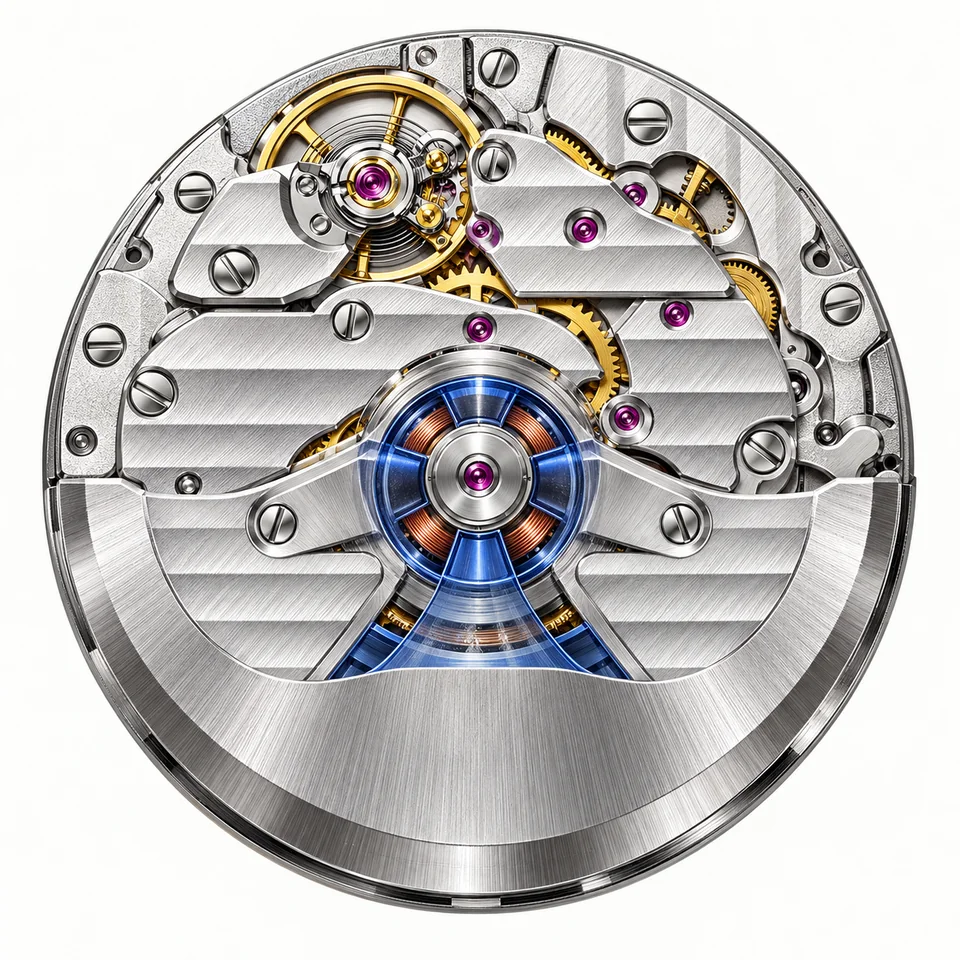 BLUE / X-RAY STUDY
Before the square watch became an icon, it began as a remarkably practical answer to an aviator’s problem.
Louis-François Cartier established the Paris maison in 1847. The family moved to 13 rue de la Paix in 1899. In 1904, Louis Cartier created a wristwatch for the pioneering aviator Alberto Santos-Dumont, who wanted to read the time without taking his hands off the controls. The Santos went on sale to the public in 1911.
ODD Montre pays tribute to this language of clean geometry, visible screws, Roman numerals, and elegant utility—while proposing its own skeleton-and-OLED interpretation. This independent concept is not made by or affiliated with Cartier.
Discover the Santos origin storyThe automatic mechanical watch has more to give. A new chapter in horology. More thoughtful engineering. More personal expression. More possibilities carried by the movement of a life.
Montre is a research direction for automatic mechanical watches: developing the movement, energy management, visible electronics and wearer experience as one considered whole. Calibre 001 is the first expression of that ambition, with an exposed mechanical heart and an integrated OLED calendar.
The present concept explores a date, moon image and responsive display. Future studies could investigate programmable personal expressions and additional functions, each guided by the available energy, space and requirements of a watch designed for lasting use.
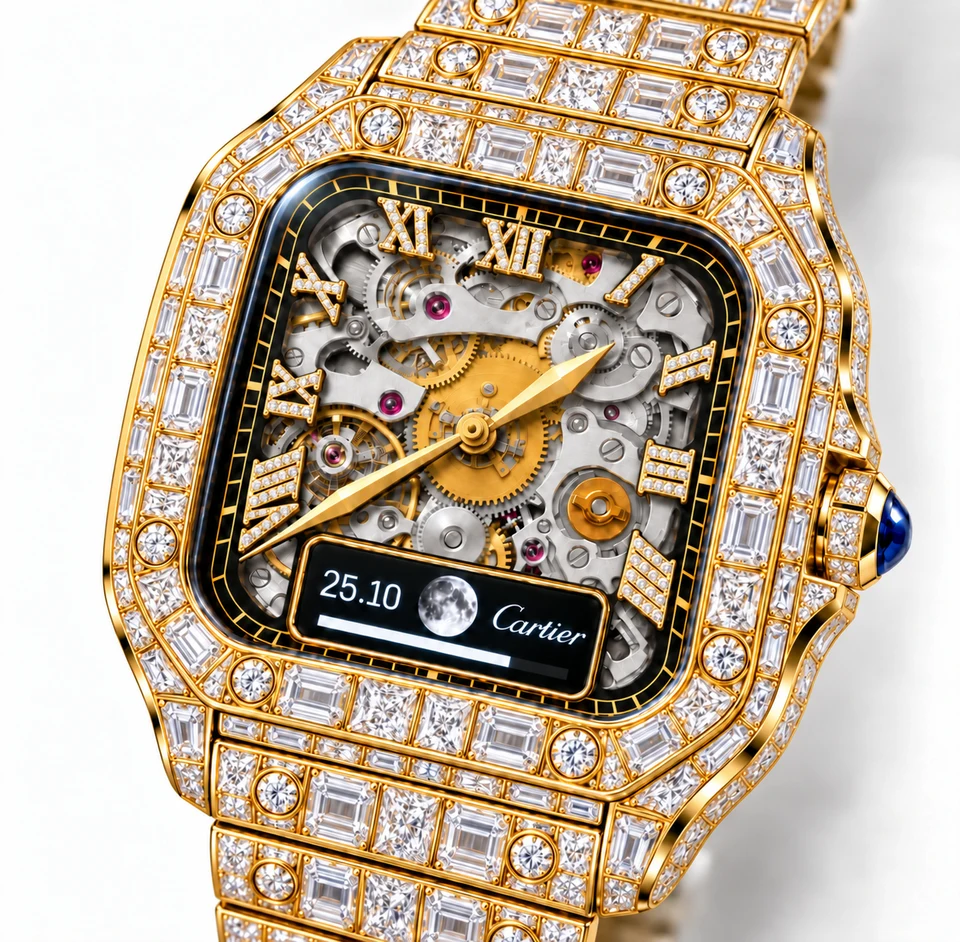
Inspired by the tradition of Parisian fine jewellery, this independent ODD Montre concept pairs an 18k yellow-gold case and bracelet with substantial diamonds of carefully contrasted cuts. Every material is part of the watch, not a decorative emblem beside it.
The dial remains completely open: diamond-set Roman numerals attach directly to the inner square perimeter, leaving the mechanical bridges and gears exposed. Broad gold hands, a blue cabochon crown and sapphire crystal complete the visual design.
Calibre 001 investigates how automatic watchmaking can accommodate new capabilities through integrated engineering. Its proposed motion-harvesting system, mechanical movement and electronic layer are parts of a wider ambition: a watch whose technology and craftsmanship advance together.
Concept presentation only. Performance and patentability are not established; all investment inquiries are preliminary and non-binding. Cartier is referenced for the proposed donor movement and heritage influence, not as a project collaborator.
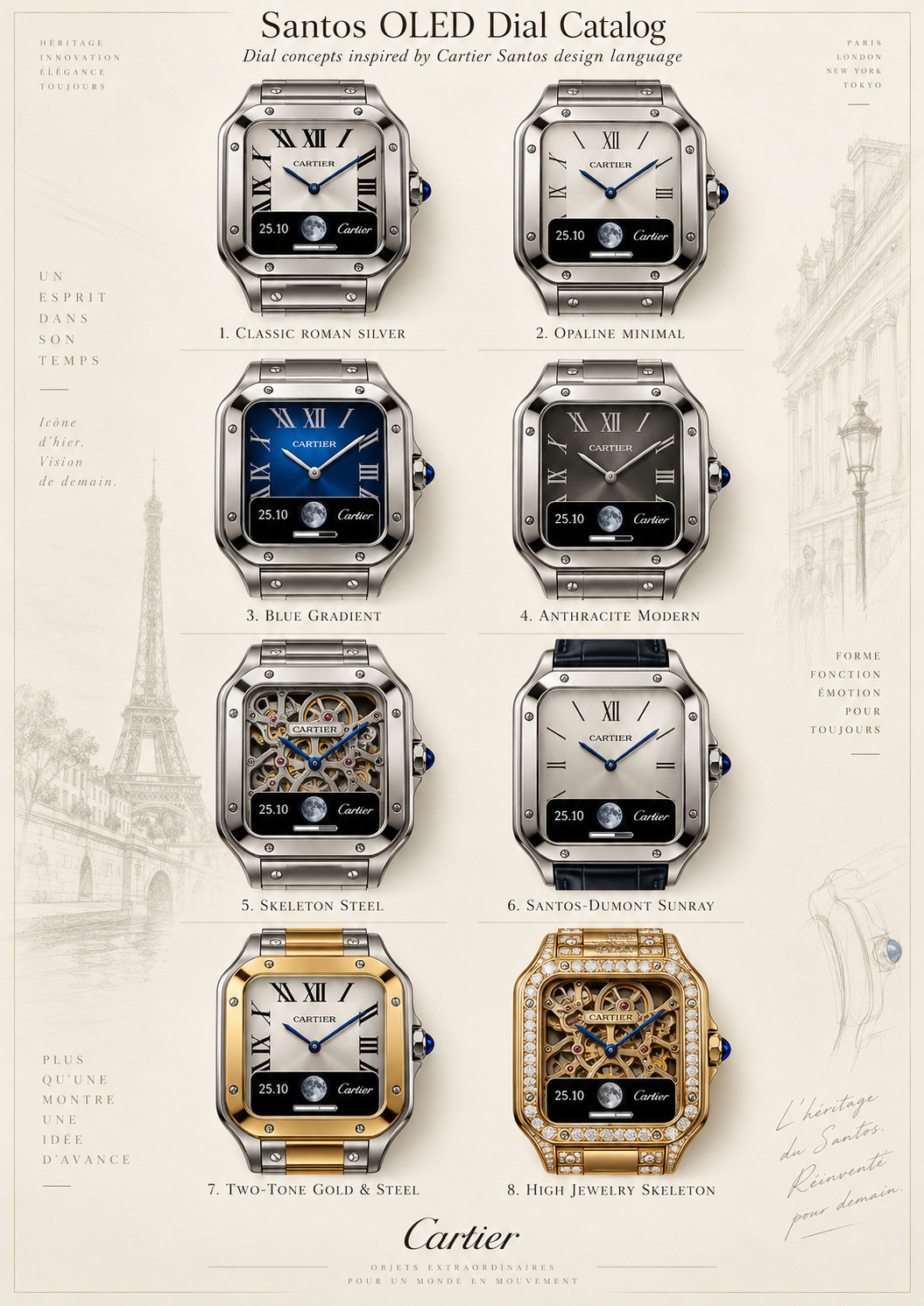
Explore the Santos-inspired dial variations, from classic Roman numerals to open-work steel and high jewellery. Select any design to enlarge it.
To those who believe automatic mechanical watchmaking still has new chapters to write,
Montre begins with our belief that the automatic mechanical watch has a remarkable future ahead of it. Centuries of craftsmanship have given us movements of extraordinary beauty and precision. We want to contribute to what comes next—to explore how that inheritance can inspire new engineering, new capabilities, and a deeper relationship between a watch and its wearer.
Our ambition reaches beyond using wrist movement to illuminate a display. We see Montre as an opportunity to explore what a mechanical watch can become when its movement, energy systems, electronics, materials, and design are developed together.
The OLED is one visible expression of that ambition. Beneath it lies a larger set of questions: How can the energy available from everyday wear be used more effectively? How can new functions coexist with reliable mechanical timekeeping? How can an intricate movement support greater personal expression while remaining beautiful, durable, and serviceable?
We believe the next achievement in mechanical watchmaking can emerge from the care with which these questions are brought together.
The exposed movement and circular circuit board give this exploration a physical language. We want their relationship to be deliberate, with each component earning its place through both function and form. The mechanical and electronic systems must be considered together, from the space they occupy to the energy they require and the way they can be maintained.
We imagine a future in which mechanical watches offer a richer range of experiences: personal displays, thoughtfully integrated information, responsive behaviour, and new ways for the wearer to interact with the object. These are possibilities to investigate. Their value will depend on how gracefully they can be realised within a watch made to be worn and cared for over time.
The Cartier and Santos tradition has inspired our appreciation for proportion, architectural clarity, and enduring elegance. Montre is our independent exploration of how that appreciation can lead toward a distinct contribution of our own. We hope to honour the spirit of invention that allows watchmaking to keep evolving.
That hope carries an engineering responsibility. Energy balance, the effect of generator loading on the mechanical system, compact packaging, reliability, and serviceability must be demonstrated. Every useful result should help us understand the next step. The research itself can become part of Montre’s contribution, alongside the watch we hope to build.
For us, progress also has an emotional purpose. A watch should invite curiosity and reward attention. It should feel personal on the wrist, reveal care in its construction, and give its owner reasons to keep looking, learning, and enjoying it. Technical achievement and affection for the object belong together.
We hope Montre can become one meaningful step in the continuing achievement of mechanical watchmaking—a project that opens possibilities, earns its promises through engineering, and encourages further imagination.
The little moon inside is a beginning. Our ambition is to help write what comes next for automatic mechanical watches. L’avenir se construit, mouvement après mouvement.
With care, ambition, and imagination,
Areg Akopyan & TeamODD Research & Development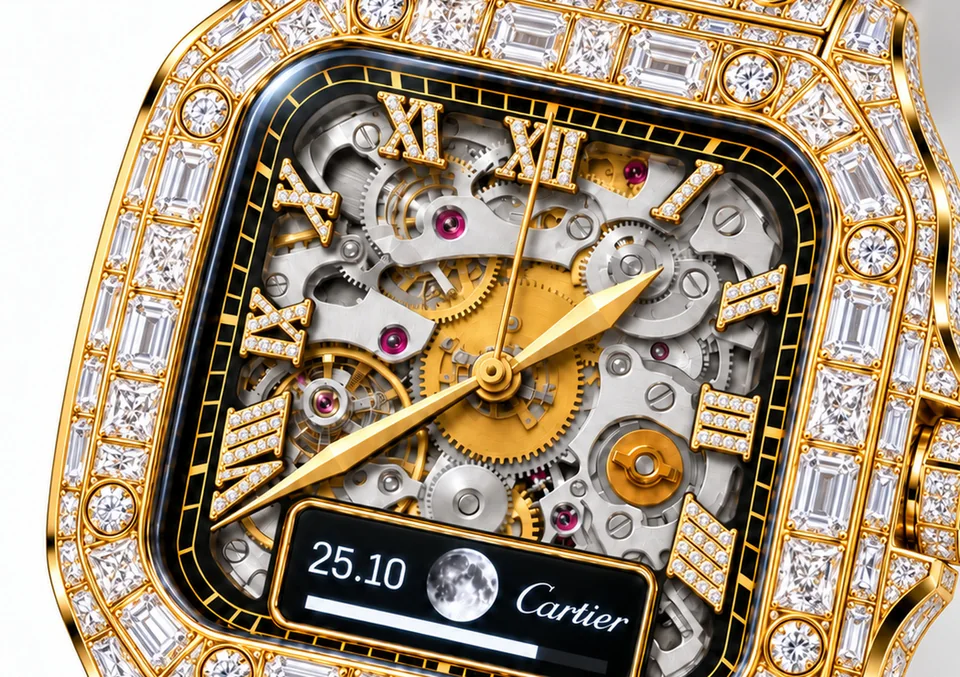
An 18k yellow-gold case and integrated bracelet conceived around substantial individual stones—not a blanket of tiny pavé. Gold outlines keep each cut distinct.
Generous square-cut stones form crisp, brilliant sections through the bracelet and case.
Elongated diamonds trace the bezel and link geometry, creating clean lines of reflected light.
Round stones are placed at the circular bolt-design locations, offering contrast to the architectural square and rectangular cuts.
Applied diamond-set numerals are anchored directly to the inner square chapter ring. No decorative crossbars or interior dial supports interrupt the exposed movement.
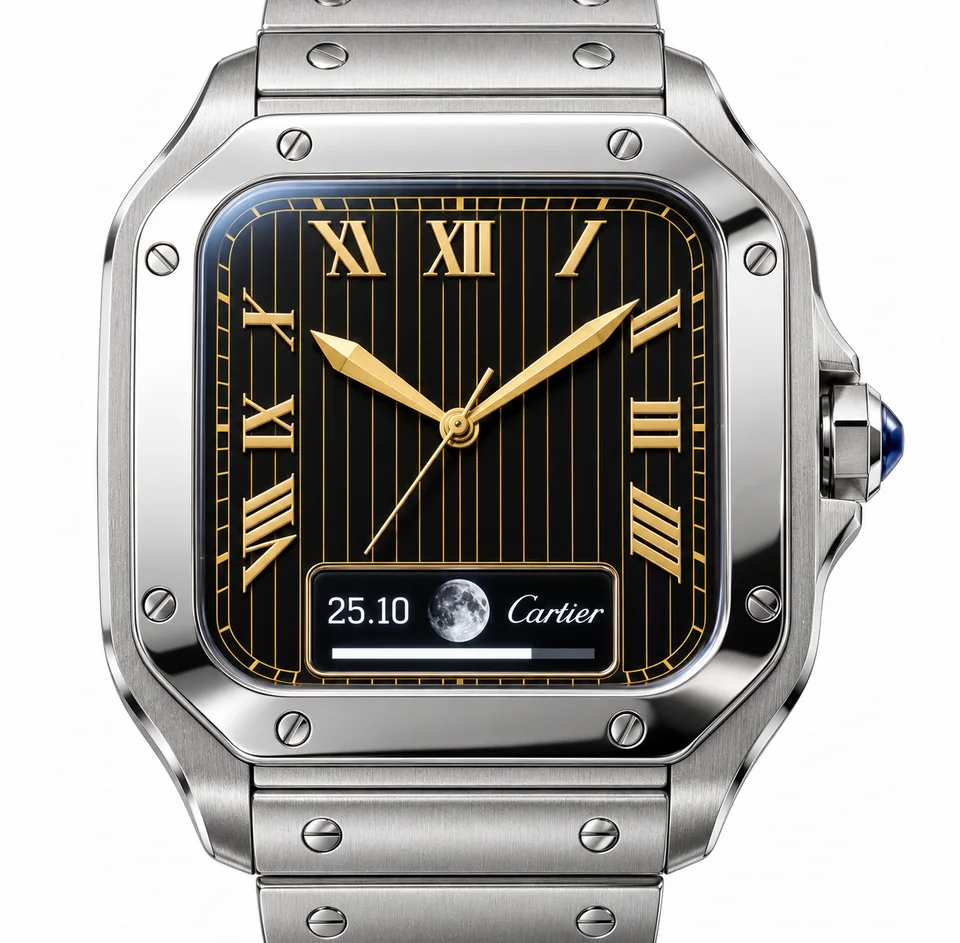
A stainless-steel case frames a black dial traced with fine gold pinstripes. Gold Roman numerals and faceted gold hands give this Santos-inspired concept a clear, architectural character.
The OLED rests at six o’clock within a gold-toned frame. This dial variation explores how a classic automatic-watch aesthetic can welcome new personal functions as part of Montre’s vision for future mechanical watchmaking.
Noir & or · Une élégance intemporelleThe OLED offers a first glimpse of the personal expression that an automatic mechanical watch could carry. This Calibre 001 preview presents the day and month, a date-aware moon image, the Cartier signature and a thin white battery bar. Its active, dim and sleep states illustrate energy-conscious interaction; further functions remain subjects for development.
Active display · motion-responsive design preview
The ring-board concept keeps the electronic layer visible: a circular chip and component path wrap around the mechanical core, while the OLED display remains at six o'clock. The dimming behavior is simple and elegant beneath the sapphire.
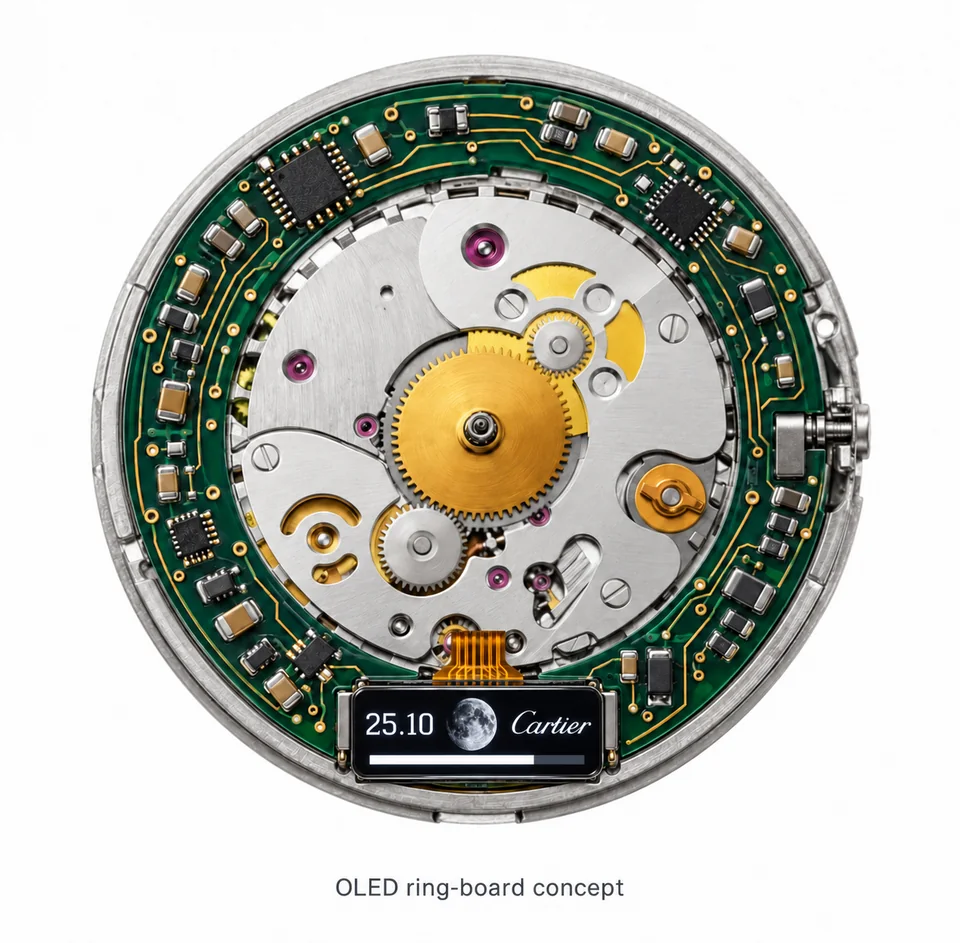
The oscillating weight is coupled to the generator rotor. Wrist movement carries the magnets past a fixed copper-coil stator, producing electrical power that is rectified and stored in the OLED battery. The proposed base calibre supplies the hands through its barrel, gear train and escapement. A separate electrical store supplies the display. Generator loading can still affect automatic winding; electrical separation does not establish mechanical isolation.
Cartier 1847 MC is the current donor reference in the concept. Final calibre selection, availability, interface drawings and modifications remain to be agreed with a development partner. The 38 mm envelope refers to the proposed complete assembly.
Barrel · gear train · escapement · mechanical handsThe discreet black display presents a numeric day and month, moon image, Cartier signature and white battery bar. It dims during inactivity and is intended to illuminate automatically when the watch is used.
Digital calendar / lunar image / sapphire glassThe crown is designed to adjust day, month and the internally stored year. A rechargeable cell and stationary microelectronics manage the display, calendar and sleep behaviour without environmental sensor readouts.
Crown-set year / no environmental sensorsThe oscillating weight drives a compact central magnet carrier above one stationary copper-wound stator at the rotor hub. The generator coil is confined to the centre, not the movement perimeter. Its changing magnetic field generates current, which a rectifier and charge controller condition for the protected rechargeable battery. As with a traditional automatic watch, the user's motion supplies the input energy—there is no proposed external charge port.
Oscillating weight → magnet rotor → fixed stator → rechargeable cellCalibre 001 is an initial packaging study within a broader vision for automatic mechanical watches. The proposed dimensions bring mechanical timekeeping, energy harvesting and electronic functions into one wearable assembly. Case and assembly sizes remain engineering targets.
All listed dimensions are design targets, not measured prototype results. Case-wall thickness, seals, crystal, hand clearance and service access require a tolerance stack-up. Concept imagery illustrates intended appearance and is not a manufactured product photograph.
A development programme should produce a reproducible technical dossier. The following work packages are proposed; no test results or acceptance thresholds are claimed here. Limits, conditions, sample counts and budget would be agreed with the partner before testing.
Characterise the oscillating weight, coupling and generator under repeatable motion profiles. Compare the same input with electrical loading enabled and disabled.
Report: resisting torque (µN·m), net energy delivered to the cell (mWh/day), active and sleep demand (µW/mW), winding efficiency and electrical autonomy for a defined display duty cycle. Identify wear profiles that cannot sustain the display.
Establish a base-calibre reference, then repeat with the integrated generator. Specify positions, temperature, state of wind and electrical load.
Report: rate (s/day), balance amplitude (°), beat error (ms) and mechanical power reserve (h). Record instrument settings and the correct lift angle. Agree permissible deviation from the reference before proceeding.
Evaluate magnetic interaction with the regulating organ, assembly clearances, thermal behaviour, shock exposure and sealing. Select test conditions for the intended use.
Report: field measurements at sensitive components, chronometric changes, dimensional stack-up, case and cell temperatures, and shock and water-resistance results. Final ratings follow testing.
Review assembly sequence, replaceable electronic modules, cell servicing, crown interfaces and access for a watchmaker.
Report: preliminary bill of materials, supplier options, estimated unit cost at stated volumes, assembly and service procedures, display ageing and cell-life assumptions. Review wearer interest and price positioning alongside technical feasibility.
Decision gates: agreed requirements → measured bench feasibility → integrated prototype → reliability and service review. Each stage ends with a documented proceed, revise or stop decision. The purpose of the first partnership is to resolve feasibility before a larger product commitment.
These official publications inform the presentation and engineering questions. They do not validate Montre or imply an affiliation.
We invite a watchmaking Maison, movement specialist or development partner to scope a feasibility study. The initial discussion would define the base calibre, energy budget, packaging limits, chronometric acceptance criteria and a responsible technical lead.
The proposed first deliverable is a measured feasibility dossier and a costed recommendation for the next prototype stage. Scope, funding, schedule and rights would be agreed before work begins.
Independent research concept. Cartier and Santos references in the visual studies do not imply endorsement, affiliation or an agreed collaboration.